.png)
Dental Crown in Turkey
A dental crown covers a tooth that has lost too much of its own structure to be restored any other way. Preparing a tooth for a full crown removes around two thirds of its visible structure, permanently. That is why, at Casas Clinics, a crown is what we recommend when nothing less will do — not as a default, and never on a healthy tooth for the sake of whiteness.
WHAT PEOPLE MEAN BY "TURKEY TEETH" — AND WHY WE DON'T DO IT
The phrase describes a specific practice: healthy teeth filed down and covered with crowns, purely for appearance, usually in large numbers at once.
The consequences are documented. A British Dental Association survey of 1,000 UK dentists found that 87% named crowns as the treatment most often needing correction after dental work abroad — ahead of implants. Half of those dentists reported repair bills above £1,000; one in five above £5,000.
The Irish Dental Association is more specific still. Their most common finding is overtreatment — patients who needed three crowns returning with ten to twenty, sometimes bonded together so tightly that floss will not pass between them.
We are a Turkish clinic. We are not going to pretend this does not happen. What we will do is tell you exactly where we stand on it, and give you the numbers so you can judge any clinic — including this one.
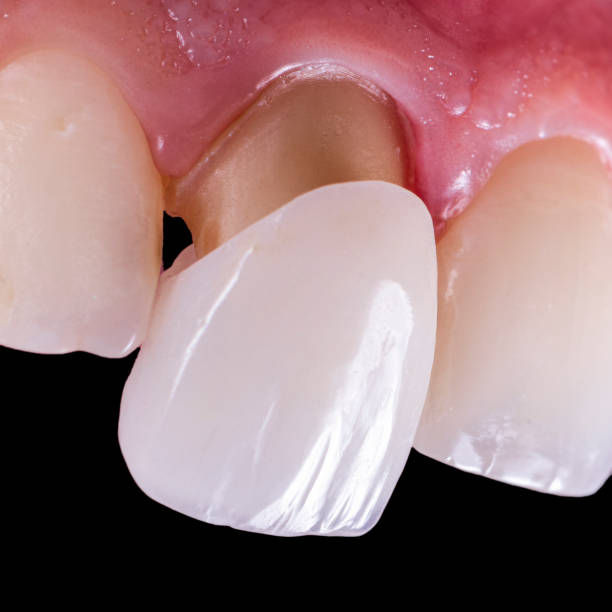
HOW MUCH OF MY TOOTH IS REMOVED FOR A CROWN?
More than most patients are told.
Measured research published in the Journal of Prosthetic Dentistry quantified it: preparing a tooth for a full ceramic or metal-ceramic crown removes between 63% and 75% of the tooth's visible structure. A conventional veneer preparation removes around 17%. A minimal adhesive preparation removes around 5%.
PreparationTooth structure removed :
Minimal adhesive restoration~5%
Conventional veneer~3-30%
Full crown (0.8 mm)~63%
Full crown (1.0 mm)~70%
Full crown (1.4 mm)~72%
A more recent volumetric study made the same point differently: in a tooth that could take either, a crown removed 25–38% of the remaining tooth, while a partial onlay removed under 8%.
Enamel does not grow back. This is the single most important fact about crowns, and it is why the first question in your consultation should not be "which crown" but "do I need one at all".
DO I ACTUALLY NEED A CROWN?
Sometimes yes. Often, something less will do the same job.
Before we propose a crown, we work through the options in order of how much of your own tooth they cost you:
-
Whitening — if the problem is only colour
-
Composite bonding — chips, small fractures, minor shape corrections
-
Orthodontics — if the problem is position, not structure. Straightening teeth does not require destroying them
-
Veneer — where the front surface needs rebuilding but the tooth is otherwise sound
-
Onlay or partial crown — where a back tooth needs cuspal protection but not full coverage
-
Full crown — where the remaining structure cannot support anything less
A crown is genuinely the right answer when: the tooth is heavily broken down or cracked; a large old restoration has failed and there is not enough sound tooth left to hold a new one; a root-treated back tooth needs its cusps protected; or the tooth is carrying a bridge.
A crown is not the right answer when the only thing wrong with your teeth is their colour or a small irregularity in shape. That is the line, and it is where most of the damage in this industry happens.
WHAT ABOUT A FULL SET OF CROWNS?
We do carry out full-mouth rehabilitation, and for some patients it is the correct treatment. A mouth that has lost height through years of wear, a dentition with failing restorations on most teeth, severe erosion — these are cases where crowning many teeth is not cosmetic. It is reconstruction.
But we make the distinction out loud, because the industry does not.
We will not crown a healthy, structurally sound tooth to make it whiter or straighter. If you come to us asking for twenty crowns and your teeth do not need twenty crowns, we will tell you, show you the scan, and propose what we think you do need. Sometimes that is a far smaller and far cheaper treatment than the one you arrived asking for.
One senior UK clinician, quoted in the British Dental Journal, put it plainly: crowning twenty teeth on a healthy young patient for cosmetic reasons would cost a dentist in Britain their licence. The standard should not change because the patient got on a plane.
WILL A CROWN MEAN I NEED A ROOT CANAL?
Sometimes. The honest numbers matter here, because this is where the arithmetic of overtreatment shows itself.
The largest study of this — 88,409 crowned teeth followed over ten years — found that roughly 3.5% went on to need root canal treatment. Longer-term follow-up of vital teeth crowned for fifteen years or more reports higher figures, because the risk accumulates rather than disappearing.
For one tooth that genuinely needed a crown, that is a reasonable risk against a real clinical benefit.
For twenty healthy teeth crowned for appearance, the same percentage means you should expect at least one root canal that you would never otherwise have had. Nobody explains this before the drill comes out. We are explaining it now.
There is a second, avoidable factor. Pulp damage is significantly more likely when temporary crowns stay on for a long time: published data puts the rate at 1.5% when temporaries are in place for two weeks or less, against 4.3% beyond that. It is one of the reasons we do not leave patients in temporaries for months.
WHICH MATERIAL WILL MY CROWNS BE?
Zirconium is our standard. It is strong, it carries no dark metal line at the gum, and it is what most of our patients receive.
For front teeth, we often recommend E-max (lithium disilicate) instead — and the evidence supports it. In a systematic review of tooth-supported single crowns, five-year survival was 96.6% for lithium disilicate against 92.1% for zirconia. Optical measurement also shows lithium disilicate transmits light noticeably better at typical crown thickness, which is what stops a front tooth looking flat.
Most clinics tell you zirconia is the best material for everything. The published comparison does not say that. We will tell you which we recommend for which tooth, and why, in writing.
Where your bite is unusually heavy or you grind, we build the restoration on a metal substructure. It is invisible, it carries the load, and it is the difference between a restoration that lasts and one that keeps coming back. We do not do this routinely — it adds cost, and most patients do not need it. We will tell you which group you are in.
WILL THEY LOOK TOO WHITE?
Only if you ask for it, and we will tell you honestly what it will look like.
A uniform, opaque, paper-white shade across every tooth is the look that made "Turkey teeth" a phrase. Natural teeth are not one flat colour: they are more translucent at the edge, slightly warmer at the neck, and they are not identical to each other.
We shade-match to your face, your age and your existing teeth. You see and approve the result at the try-in stage, while you are still in Istanbul, before anything is cemented.
WHAT ABOUT THE GUM LINE?
This is the technical reason behind the photographs you have seen of red, swollen gums around new crowns.
There is a zone of about 2 mm between the bottom of the gum pocket and the bone, occupied by soft tissue attachment. It has a name in dentistry — the biologic width — and if a crown margin is pushed down into it, the body responds with chronic inflammation, gum recession and bone loss. That response is often permanent.
We finish crown margins at or above the gum line wherever the case allows, and go below it only where aesthetics genuinely require it. Margins you can clean are margins that last.
The same principle applies to the shape between teeth. Crowns joined together so that floss cannot pass are easier to make and impossible to keep clean. We do not make them that way.
WHAT IS A ''PEG TOOTH'' AND WILL MY TEETH LOOK LIKE THAT?
"Peg teeth" is the term used for an over-aggressive preparation — a tooth cut down into a thin tapered stump, far more than the crown actually requires.
It happens when preparation is rushed, or when a clinic is preparing many teeth in a single long session. It leaves less tooth to hold the crown, brings the drill closer to the nerve, and cannot be undone.
Preparation depth is a controlled measurement, not a matter of style. We prepare to the minimum the material requires, and you can ask to see your own photographs at any stage.
HOW LONG DO CROWNS LAST?
Two honest numbers, because they differ and you should see both.
In controlled clinical studies, five-year survival for modern single crowns runs between roughly 92% and 99% depending on material and position.
In the real world, the largest dataset available — around 1.2 million crowns placed across England and Wales — reports 77% still in place at five years, 63% at ten, and 53% at fifteen.
The gap between those two sets of figures is the difference between ideal conditions and ordinary life. Treat the real-world numbers as the ones that apply to you: roughly a third of crowns need some intervention within ten years.
A crown is not a permanent solution. It is a long-term one, and it starts a maintenance relationship with that tooth for the rest of its life.
CAN A CROWN BE REVERSED?
No. This is the part that deserves a straight answer.
Once a tooth has been prepared, the structure removed is gone. A crown can be replaced, and each replacement usually costs a little more tooth. If crowns were placed on teeth that did not need them, the teeth underneath cannot be restored to what they were.
Poorly made crowns can be redone, and badly planned cases can often be substantially improved. But "reversed" is the wrong word, and any clinic that uses it is not being straight with you.
HOW LONG WILL I BE IN ISTANBUL?
Crown treatment is usually completed in one visit of five to seven days: preparation and digital scanning at the start, try-in mid-visit, and fitting of your final crowns before you fly home.
Keeping it to a single short visit is not only convenient. As noted above, long periods in temporary crowns raise the risk of pulp damage — which is a clinical reason to finish the work properly rather than send you home half-treated.
Where teeth need root canal treatment, extraction or gum treatment first, your plan may need two visits. We tell you which before you book anything.
WHAT YOU TAKE HOME WITH YOU
Your written five-year guarantee. A signed, dated contract in your name. If a complication arises from treatment we performed, the revision is carried out here free of charge for five years.
Your crown record. Material, brand, shade, laboratory and date for every unit fitted. A dentist at home who knows exactly what is in your mouth can look after it. One who does not is being asked to guess — and that is the real reason behind "dentists won't touch work done abroad".
Your treatment record, X-rays and photographs, including your before images.
WHY IS THIS DONE INSIDE A HOSPITAL?
Casas Clinics is a registered medical unit of Private Florya Hospital in Istanbul, with cardiology, internal medicine, anaesthesiology, intensive care and a 24-hour emergency department in the same building.
For routine crown work this rarely matters. It matters when a case involves extractions, surgery, sedation or general anaesthesia — and it matters if you have a heart condition, diabetes, a respiratory illness or you take blood thinners. Those patients are reviewed by the relevant hospital specialist before treatment begins, rather than turned away.
_edited.jpg)
WHAT DO CROWNS COST IN TURKEY COMPARED WITH THE UK?
On the NHS, crowns fall under Band 3, currently £332.10 per course of treatment. That figure is real, and it is worth understanding what it does and does not mean: NHS crowns are provided where there is a clinical need, not for cosmetic reasons; the material is not your choice; and access is the constraint — as of mid-2025, fewer than 40% of adults in England had seen an NHS dentist in the previous two years.Private crowns in the UK are commonly quoted in the range of £400 to £1,200 depending on material. In Ireland, the Irish Dental Association gives a figure of €600 to €850.
Our prices are published in full, and the figure you are given before you travel is the figure you pay.
[ See our full price list → ]
FREQUENTLY ASKED QUESTIONS
Do crowns ruin your natural teeth?
A crown permanently removes around two thirds of the tooth's visible structure. On a tooth that is already broken down, that is a worthwhile trade. On a healthy tooth, it is damage with no clinical benefit — which is why we do not do it.
How much of my tooth is shaved down for a crown?
Between 63% and 75% of the visible structure, according to measured research. A veneer removes around 17%, a minimal adhesive restoration around 5%.
Do they shave your teeth in Turkey?
Some clinics do, on teeth that did not need it. That practice is real and it is what created the phrase "Turkey teeth". It is a question about the clinic, not about the country — and the way to answer it is to ask any clinic what they will remove, and why, before you agree to anything.
Do I need a crown or a veneer?
If the tooth is sound and the issue is appearance, a veneer or bonding is usually the right answer. If the tooth is broken down, a veneer will not hold. We will show you the scan and explain which applies to you.
Can Turkey teeth be reversed?
No. Removed tooth structure does not come back. Poor crowns can be replaced and badly planned cases improved, but the underlying teeth cannot be restored to their original state.
Will I need a root canal after having a crown?
Around 3.5% of crowned teeth need root canal treatment within ten years, with the figure rising over longer periods. The risk is small for one necessary crown, and adds up quickly across a full set of unnecessary ones.
Why do clinics in Turkey put crowns on healthy teeth?
Because crowns are quick, sold in large numbers, and produce an immediate visual change. It is a commercial answer rather than a clinical one.
Are Turkey teeth the same as veneers?
No, and the confusion matters. Most of what is shown as "veneers" on social media is actually full crowns. The difference is roughly 17% of your tooth against 70%.
How long do dental crowns last?
In the largest real-world dataset, 77% are still in place at five years, 63% at ten and 53% at fifteen. Controlled studies report higher figures. Expect maintenance rather than permanence.
Which is better for front teeth — zirconia or E-max?
For front teeth, the published evidence favours E-max: higher five-year survival for single crowns and better light transmission. Zirconium remains our standard elsewhere, particularly where strength matters most.
Will they look too white?
Not unless you ask for that. We shade-match to your face and existing teeth, and you approve the result at try-in, in Istanbul, before anything is cemented.
Does getting a crown hurt?
Preparation is done under local anaesthetic. Sensitivity for a few days afterwards is common. For anxious patients, sedation and general anaesthesia are available, given by hospital anaesthetists.
How many days do I need to stay in Turkey for crowns?
Usually one visit of five to seven days. If teeth need root canal treatment, extractions or gum treatment first, your plan may need two visits — and we will tell you that before you book.
Will a UK or Irish dentist look after crowns fitted in Turkey?
Many will, particularly when you can tell them exactly what was fitted. You leave with a full crown record: material, brand, shade, laboratory and date.
Would you ever tell me I don't need crowns?
Yes. It happens regularly. If your teeth do not need crowning, we will say so and propose what we think you do need — which is often smaller and cheaper than what you came asking for.